Wind energy. Wind power. Sustainable, renewable energy. Wind turbines generate electricity. Windmill farm on mountain with sunset sky. Green technology. Renewable resource. Sustainable development.

environmental sustainability
The pursuit of environmental sustainability is a must for every company and for each individual.
We have always been committed to preserving the planet’s resources across all of our activities, with the aim of leaving it in a better state for future generations.
This vision of work is one of the main challenges that Chimpex has set itself in recent years: to increasingly adapt its activities to the so-called circular economy.
This goal represents the consolidation of a long-standing commitment to the defence of green issues, as witnessed by the numerous awards and ISO certifications in the environmental field.
It is our conviction that respect for the environment is ingrained in the very essence of the chemical industry. The search for sustainable solutions for the manufacturing sector, the effort to find new life for spent materials and waste, the production of goods necessary for sanitisation and purification processes – all of these must be the ‘bread and butter’ of every company operating in the chemicals industry.

Our sustainable vision
Chimpex’s main investments in recent years – the production of AdBlue and the refinement of the Resin Infusion technique – are in keeping with this vision.
At our Naples site, there is a modern plant for the production of AdBlue additive, an indispensable ingredient for diesel engines, equipped with SCR catalysts to reduce nitrogen oxide emissions in exhaust fumes.
In the plastics and composites sector, the Resin Infusion technique has been perfected for the production of fibreglass parts. This effort has enabled us to reduce the use of consumables and the waste of resources, as well as to eliminate the dispersion of styrene into the environment.
Our Green Strategy
At Chimpex, our belief in the circularity of the economy means striving to make investments in green chemistry, to launch projects for the development of reusable packaging, smart sourcing and recycling models, as well as innovative smart storage and transport solutions.
The guidelines of our commitment to environmental sustainability are as follows:
- saving resources
- reduction of environmental impact
- sustainability of materials
- creation of a sustainable value chain
- product safety
- creation of an Eco-Friendly Portfolio with net zero Co2 emissions
Created with GIMP
Chimpex seeks to provide maximum transparency in supply relationships by creating a sustainability chain of chemical substances in which the entire process of the production, use and distribution of chemical substances takes place as part of a transparent, traceable supply chain. The aim is to identify eventual risks to users and the environment stemming from the presence of dangerous chemical substances by offering alternative solutions in terms of product/process where they are available.
However, some substances are still not technologically replaceable or there is no alternative which, in overall terms, is less dangerous. In these cases, the protection of the environment and health can be achieved through the appropriate application of restrictions and legal bans. An improvement in the level of sustainability is therefore possible through the application of suitable management protocols.

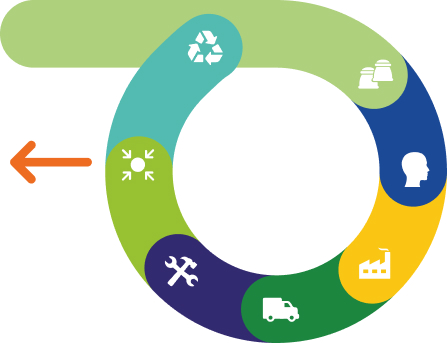
Our circular
economy
Distribution
Consumption, use, reuse, repair
Collection
Raw materials
Design
Production and remanufacturing
Recycling
Key points
of the strategy
Exclusive enhancement of suppliers that guarantee a low environmental impact and zero waste.
Consolidation of the local supply chain.
Support for partnerships with producers that develop new green technologies for their manufacturing processes.
Optimisation of the portfolio of packaging solutions, improvement of the reuse, washing systems and recycling of containers.
Abatement of excessive waste by focusing on the adoption of alternative materials.
Reduction of the impact of manufacturing processes by developing systems that ensure lower energy consumption
Extension of storage areas that enable the storage of a larger volume of raw materials to reduce transport.
Smart transportation organised between various storage units.